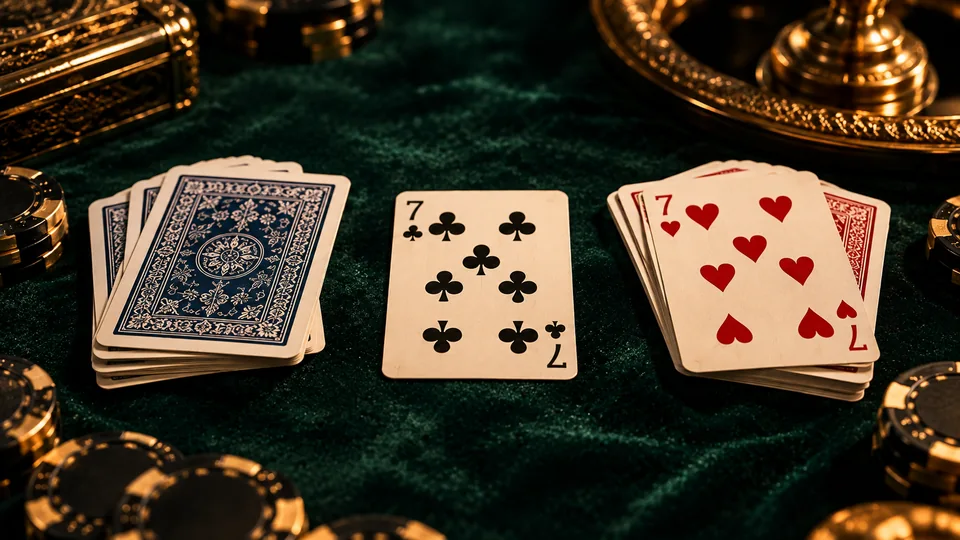
The reference card and the match
A reference card establishes the rank to match. Further cards are dealt into the Andar and Bahar positions until a matching rank appears. The supplier description for Super Andar Bahar illustrates this mechanism with an alternating deal; its named product also has additional features.
Evolution — Super Andar Bahar game description ↗Do not assume every version starts with the same side or uses the same extra features. The reference card is sometimes called the Joker in a product description; that label does not necessarily mean a separate wildcard has been added to the deck.
An illustrative deal
| Step | Card | Meaning |
|---|---|---|
| Reference | 7♣ | A rank-seven card ends the subsequent deal |
| First side | K♦ | No rank match |
| Second side | 2♠ | No rank match |
| First side | 7♥ | Matching rank; this illustrative deal ends |
The table uses “first side” and “second side” deliberately. Apply actual side labels only after checking the rule sheet. This is an invented example, not a captured game round.
Why the first card is not a 50/50 event
Assume one standard 52-card deck, a reference card removed, and a uniform random ordering of the remaining 51 cards. Three cards of its rank remain. The chance of an immediate match on the first dealt card is 3/51 = 5.8824%.
This is the probability of one early stopping event, not the final probability that a labelled side wins. The final outcome combines all possible stopping positions. An alternating deal groups odd and even positions, and their total probabilities should be calculated rather than assumed.
Read the payout separately
A probability and a payout are different objects. A side can win more frequently but pay less on a qualifying result. Additional card-count wagers or multipliers create separate outcomes with their own conditions. A headline multiplier is not a probability.
For any calculation, identify the deck, starting side, stopping rule and settlement rule. Changing one assumption can invalidate a figure borrowed from another version.
How to read a strategy claim
A sequence of past results does not itself reveal the next uniformly shuffled deal. Any purported prediction must explain the information available before the outcome and provide evidence beyond selected screenshots. “Choose the side that has not won recently” is not a probability calculation.
Understanding this card mechanism helps evaluate marketing claims. It does not establish permission for real-money online play in India or a guaranteed return.
For the wider context, read our India online casino guide.
Common questions
Do Andar and Bahar necessarily have equal chances?
No. The dealing and stopping assumptions must be analysed. Two labels alone do not establish equal chances.
Are all Andar Bahar products the same?
No. Starting order, deck treatment, additional wagers and payouts may differ.
Sources & notes
Sources checked 14 October 2026. Prepared with AI assistance and checked against the linked sources.